Resume Passes ATS But Gets Rejected? Here's Why
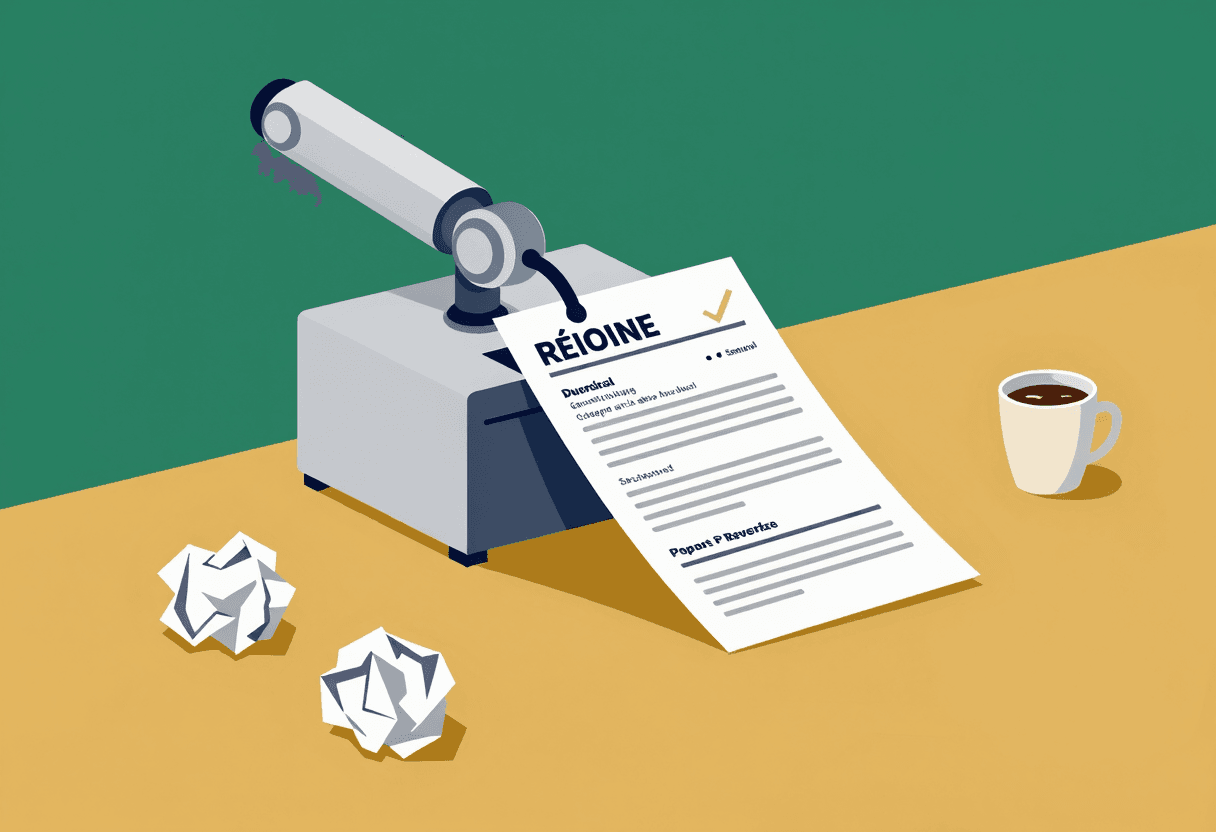
The ATS Is the Gatekeeper, Not the Decision Maker
Let me tell you what happens after your resume passes the ATS. It lands in a folder with 40 other resumes that also passed. A recruiter opens it at 2:47 PM on a Wednesday, third coffee wearing off, seven more reqs to fill before end of quarter. They have 8-12 seconds before they decide whether to keep reading or move to the next candidate.
The ATS got you in the room. The human kicks you out.
I've reviewed over 10,000 resumes across eight years of corporate recruiting. The gap between what passes ATS and what convinces a human is where most candidates die. You spent hours keyword-optimizing. You reformatted for parsing. You checked every box the internet told you mattered for algorithms. Then a person glanced at it and thought: 'This reads like a robot wrote it.'
That's the problem. ATS optimization has become so obsessive that resumes now pass bots beautifully and fail humans catastrophically. You're solving for the wrong reader.
What ATS Checks vs. What Humans Judge
The ATS is binary. It scans for keywords, parses formatting, matches job titles to requirements, and scores your resume against a rubric. If you hit 70% match on their criteria, you pass. It doesn't care if your bullet points make sense. It doesn't judge whether your career story is coherent. It's checking boxes.
Humans operate on pattern recognition and gut reaction. We're scanning for red flags in the first three seconds. We're asking: Does this person's trajectory make sense? Do the accomplishments sound real? Is this resume trying too hard? Can I picture this person in the role?
Here's what the ATS evaluates:
- Keyword density and match percentage
- Proper section headers (Experience, Education, Skills)
- Date formatting consistency
- File type compatibility (PDF vs. Word)
- Absence of tables, text boxes, headers/footers that break parsing
Here's what humans evaluate in the first 10 seconds:
- Visual hierarchy—can I scan this quickly?
- Job title progression—does this career path make sense?
- Company names—do I recognize any of these?
- Tenure—any job-hopping red flags?
- Bullet point quality—do these sound like real accomplishments or generic fluff?
The ATS passed you because you listed 'project management, stakeholder communication, cross-functional collaboration' fourteen times. The human rejected you because every bullet point was a keyword salad with no actual outcome.
Red Flag #1: Your Resume Reads Like Keyword Soup
This is the most common failure mode I see in 2026. Candidates are so terrified of ATS rejection that they cram every possible keyword into every sentence until the resume stops sounding human.
Bad example:
Leveraged cross-functional stakeholder engagement and agile project management methodologies to drive strategic initiatives and optimize operational efficiency across multiple business units while utilizing data-driven insights.
That sentence hits maybe eight keywords. It also says absolutely nothing. What did you actually do? What was the result? I have no idea, and I'm not going to re-read it to find out.
Good example:
Led a 6-person team to launch new vendor portal, reducing onboarding time from 14 days to 3 days and cutting support tickets by 40%.
Fewer keywords. Infinitely more compelling. I know what you did, how you did it, and what happened because of it. The ATS still picks up 'led,' 'team,' 'launch,' 'onboarding,' and 'support'—but now a human actually wants to keep reading.
Red Flag #2: Zero Readability or Visual Hierarchy
You followed every ATS formatting rule. Single column, standard fonts, no graphics, clean section headers. Your resume parses perfectly. It's also a visual nightmare to read. According to research from Ladders, recruiters spend an average of 7.4 seconds on an initial resume scan. If your resume looks like a wall of text, we're not reading it.
Common readability killers:
- Bullet points that run 3-4 lines each
- No white space between sections
- Tiny 10pt font crammed to fit everything on one page
- Inconsistent formatting (some bullets bold, some not, random italics)
- Paragraph-style experience descriptions instead of scannable bullets
I've seen resumes that pass ATS with 95% keyword match and get rejected in four seconds because they're formatted like a legal contract. The recruiter's eyes glaze over. They move on. Length matters less than scannability. A two-page resume with clear hierarchy beats a one-page text block every time.
What Good Visual Hierarchy Looks Like
- Job titles and company names stand out (bold or slightly larger font)
- Dates are right-aligned so tenure is immediately visible
- Bullet points are 1-2 lines max, with the impact in the first 8 words
- White space between sections so the eye can rest
- Consistent formatting throughout—no random bold, no unexplained italics
Your resume should guide my eye down the page in a logical flow. If I have to hunt for information or decode your formatting choices, I'm closing the PDF.
Red Flag #3: Your Career Story Makes No Sense
The ATS doesn't care if your career progression is coherent. Humans do. We're looking for a narrative thread. Why did you make this move? Why are you applying here? Does this trajectory suggest you'll succeed in our role?
I see resumes that pass ATS but tell a story that raises immediate questions:
- Three job changes in 18 months with no explanation
- A senior title followed by an individual contributor role two jobs later
- Industry jumps that seem random (finance to education to SaaS in three years)
- Gaps that aren't addressed and make me wonder what happened
None of these are automatic disqualifiers. But if you don't address them, I'm inventing my own narrative—and it's usually worse than reality. Career changers especially need to connect the dots explicitly. Don't make me guess why you're qualified.
The fix: add a one-line context note under job titles when needed. 'Contract role during company acquisition.' 'Returned to IC work to deepen technical skills.' 'Career pivot to focus on data analytics.' Ten words that prevent me from making up a worse story.
Red Flag #4: Accomplishments That Sound Fake or Inflated
You passed ATS because you wrote 'increased revenue by 300%' and 'reduced costs by 50%' and 'improved efficiency by 200%.' You got rejected because I've seen 40 resumes this week with identical claims, and most of them are bullshit.
Recruiters develop a sixth sense for inflated accomplishments. We know what's plausible for a given role and level. When the numbers don't match the title, we get suspicious.
Accomplishments that trigger my bullshit detector:
- 'Single-handedly' anything (you didn't, and claiming it makes you look naive)
- Percentages without context ('increased engagement 400%' from 1 user to 5 users?)
- Taking credit for company-wide results ('grew company from $10M to $50M' as a mid-level IC)
- Vague impact claims with no specifics ('significantly improved team performance')
- Every bullet point ending in a percentage increase
The fix isn't to remove metrics. It's to make them believable and specific. Instead of 'increased sales 200%,' write 'grew territory sales from $400K to $1.2M over 18 months by expanding into healthcare vertical.' Now I believe you.
The Specificity Test
If you can't answer these three questions about an accomplishment, it's too vague:
- What was the before state?
- What did you personally do?
- What was the after state, with a number?
'Improved customer satisfaction' fails this test. 'Redesigned onboarding email sequence, reducing time-to-first-value from 7 days to 2 days and increasing Day 30 retention from 60% to 78%' passes it. Be that specific.
Red Flag #5: You Didn't Tailor It (And It Shows)
The ATS doesn't care if you're genuinely interested in this specific role. It's checking keyword match. Humans care a lot. We can tell when you've sent the same generic resume to 100 companies. And according to a 2024 Jobvite survey, 63% of recruiters say tailored resumes significantly increase a candidate's chances of getting an interview.
Signs your resume isn't tailored:
- Generic objective or summary that could apply to any job
- Skills section that lists 30 technologies with no prioritization
- Bullet points that emphasize experience irrelevant to this role
- No mention of the specific tools, methodologies, or domains in the job description
- A title or branding statement that doesn't match what they're hiring for
Tailoring doesn't mean rewriting from scratch. It means reordering and emphasizing the experience that matters most for this role. If they want someone with SaaS sales experience and you have it, that should be prominent in your first three bullets—not buried in job #4.
How to Satisfy Both the Bot and the Human
You don't have to choose between ATS optimization and human appeal. You need both. The strategy is simple: write for humans first, then layer in ATS requirements without sacrificing readability.
Step 1: Write Accomplishment-Driven Bullets
Start with what you did and what happened because of it. Use the formula: Action verb + specific task + measurable result. 'Launched new customer portal, reducing average support ticket resolution time from 48 hours to 6 hours and cutting support costs by $120K annually.'
This reads well. A human understands it immediately. Now audit it for keywords.
Step 2: Audit for Missing Keywords
Compare your bullets to the job description. Are there critical terms missing? Add them naturally. If the JD mentions 'Salesforce' and you used it, add it: 'Built automated workflows in Salesforce, reducing manual data entry by 15 hours per week.' You've added the keyword without making the sentence robotic.
Step 3: Test Readability
Read your resume out loud. If you stumble over phrasing or a sentence takes three tries to parse, rewrite it. If your bullet points sound like they were written by a legal compliance team, simplify them. Humans trust clear, direct language. Buzzword soup makes us suspicious.
Step 4: Check Visual Hierarchy
Print your resume or view it at 75% zoom. Can you identify the most important information in 5 seconds? If not, adjust formatting. Bold job titles. Add white space. Shorten bullets. Make it scannable.
Step 5: Get a Human Second Opinion
Send your resume to a friend who doesn't know your career history. Ask them to skim it for 10 seconds and tell you what you do and why you're qualified. If they can't answer, your resume isn't clear enough. Revise and test again.
The Real Problem: You Optimized for the Wrong Audience
The internet has convinced job seekers that the ATS is the final boss. It's not. It's the bouncer. The hiring manager is the final boss, and the recruiter is the gatekeeper who decides if you get to meet them.
Most resume advice focuses obsessively on beating the ATS because it's a clear, solvable problem. Add keywords, use standard formatting, avoid tables—done. Human appeal is harder to systematize. It requires judgment, clarity, and storytelling. It requires you to think like the person reading your resume at 2:47 PM on a Wednesday, deciding whether you're worth a phone screen.
That's the gap. You spent hours optimizing for an algorithm that takes 0.3 seconds to evaluate you. You spent zero time thinking about the human who will spend 8 seconds deciding your fate.
The ATS is a filter. The recruiter is a decision maker. Passing the filter means nothing if you lose the decision maker in the first paragraph.
Fix that, and you'll stop wondering why you're passing ATS but getting rejected. The bot never rejected you. The human did. Write for them.
Build a resume that satisfies both ATS and human readers—start free.
Learn moreFrequently asked questions
Why does my resume pass ATS but get rejected by recruiters?+
Passing ATS means you matched enough keywords and formatted correctly for parsing. Getting rejected by recruiters means your resume failed the human test: poor readability, keyword-stuffed bullets that say nothing, unclear career progression, or inflated accomplishments that don't sound credible. ATS is a filter; recruiters make the hiring decision.
What do recruiters look for after a resume passes ATS?+
Recruiters scan for visual hierarchy, clear job progression, recognizable company names, reasonable tenure, and accomplishment bullets that sound real and specific. We're asking: Does this career story make sense? Can I picture this person succeeding here? Does anything raise a red flag? You have 8-12 seconds to answer those questions.
How is human resume review different from ATS screening?+
ATS checks keyword match, formatting, and parsing compatibility—it's binary and doesn't judge quality. Humans evaluate readability, story coherence, credibility of claims, and cultural fit. ATS asks 'Does this resume contain the right words?' Humans ask 'Would I want to interview this person?' Passing one doesn't guarantee passing the other.
Can a resume be too optimized for ATS?+
Yes. Over-optimization leads to keyword-stuffed bullets that sound robotic, walls of text with no white space, and generic phrasing that says nothing specific. You pass the bot but lose the human. The fix: write for humans first, then audit for missing keywords and add them naturally without sacrificing readability.
Should I prioritize ATS optimization or human readability?+
Both. Write accomplishment-driven bullets that a human finds compelling, then layer in ATS keywords naturally. Test readability by reading aloud and checking visual hierarchy. If your resume sounds like a compliance document, you've over-optimized. If it's missing critical keywords from the job description, you'll get filtered. Balance both.
Written by
Jordan MitchellRecruiting Insider
Former corporate recruiter. 10,000+ resumes screened, 3,000+ interviews conducted.